Finding the Balance Between Efficiency and Green
CompletedInvestigates how logistics companies can cut delivery-fleet carbon emissions without missing service deadlines, using real GPS trip data and a physics-based driving simulation. Finds an eco-driving "sweet spot" that cuts emissions by up to 16.5% on congested urban routes while still meeting delivery-time commitments.
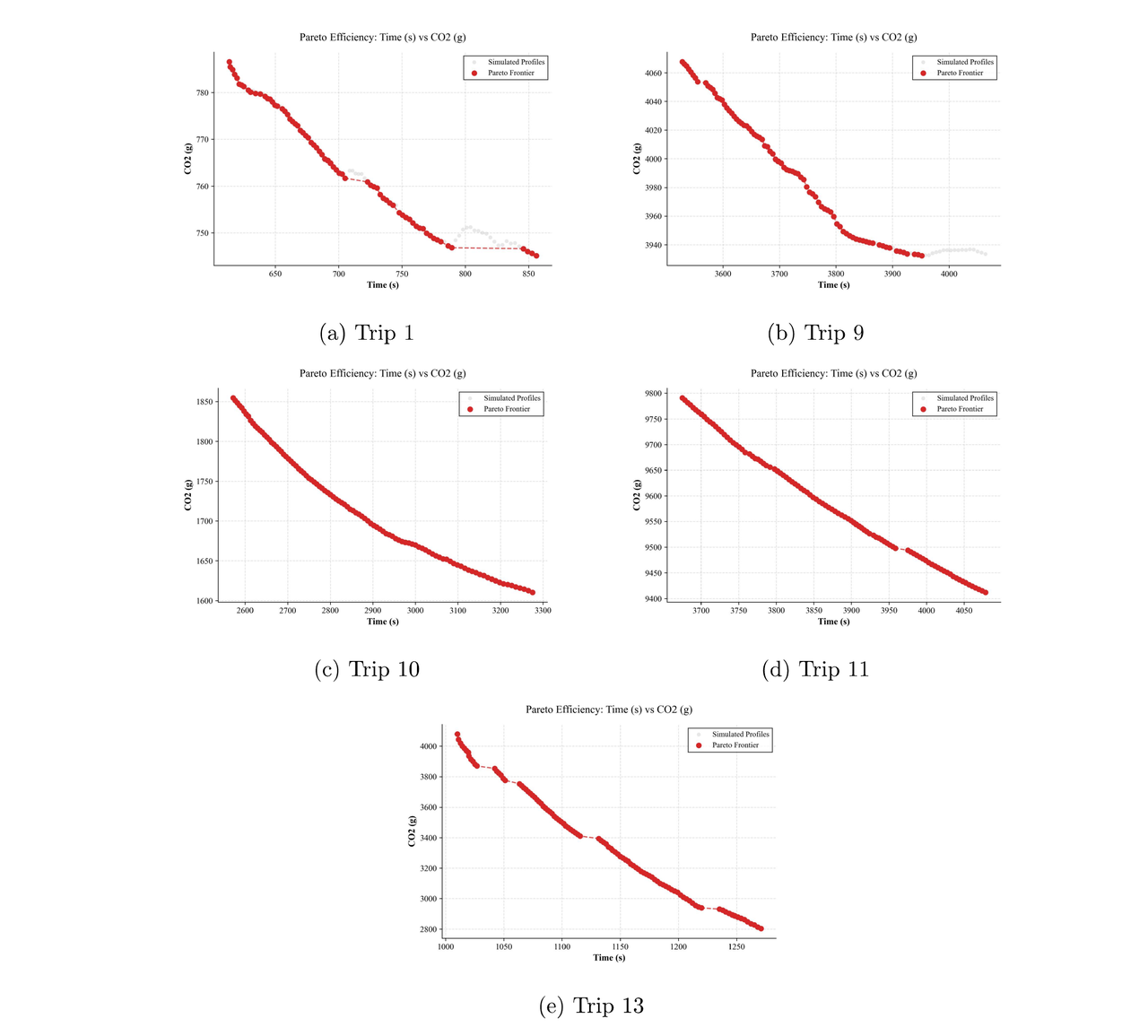
A multi-objective optimization thesis for Maastricht University's School of Business and Economics, supervised by Dr. Burak Can, tackling the operational trade-off between time-based efficiency and environmental sustainability in time-sensitive B2B logistics. Built a white-box simulation framework — combining the ISO 23795 standard, WLTP drive-cycle classification, and a Random Forest classifier — over a granular GPS dataset of 19 trips across Europe and Aruba, then ran a segment-based physics engine across 100 driver profiles to trace the Pareto frontier between speed and emissions. The results identify an eco-driving "frontier knee" (α ∈ [0.4, 0.6]) as the optimal trade-off: a 7.74% emissions reduction unladen, rising to 9.36% fully loaded and up to 16.51% in congested urban corridors, all while keeping fleets within contractual SLA windows — directly relevant as EU ETS-2 regulations put a price on freight carbon.